
 Available in US
The Duckworth-Lewis-Stern Method for Cricket Betting
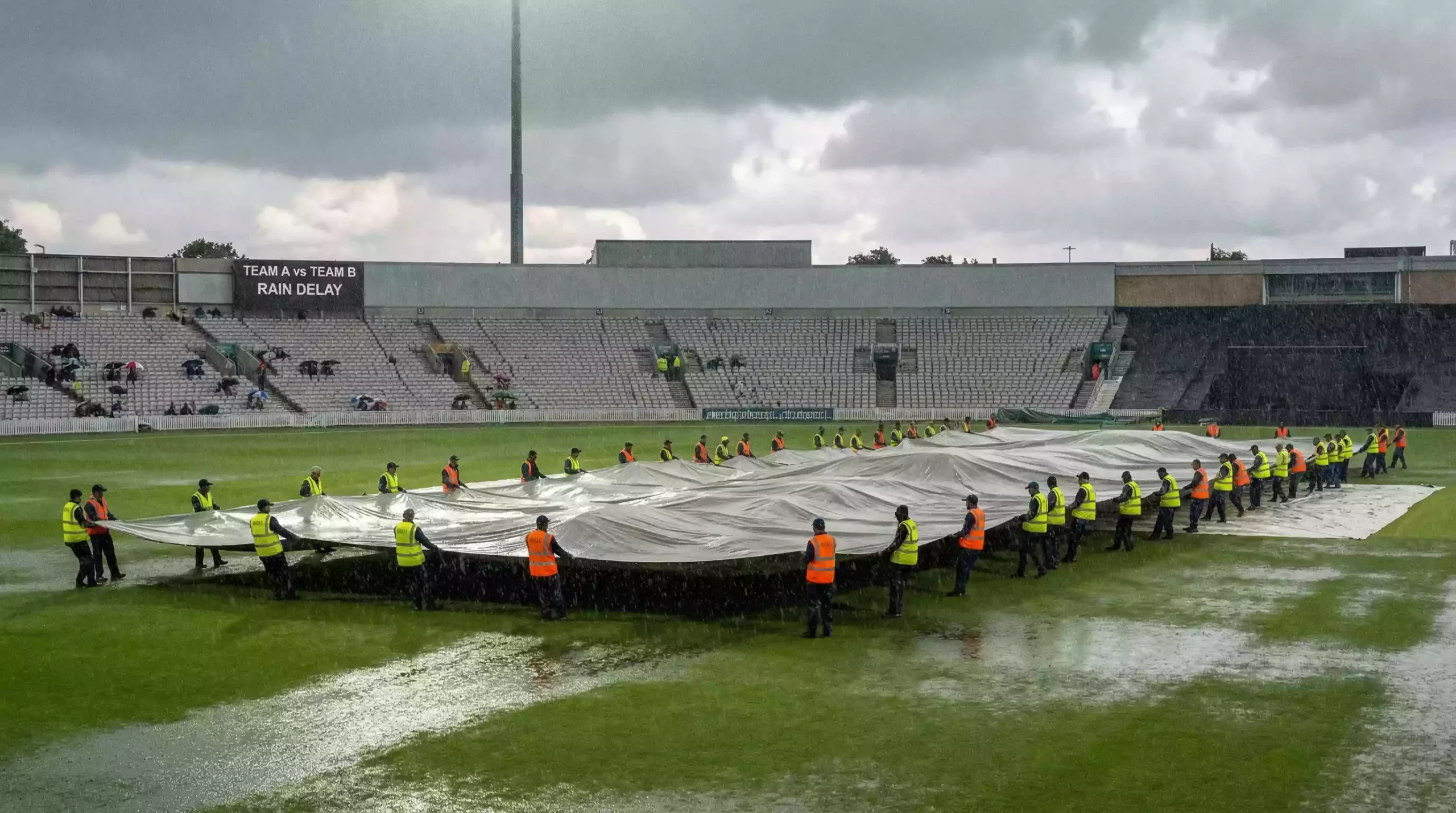
Rain is the uninvited guest at every limited-overs cricket match, and when it arrives, it brings the Duckworth-Lewis-Stern method with it. DLS is the mathematical formula that recalculates targets in rain-interrupted ODIs and T20s, and it is simultaneously the most important and the least understood tool in a cricket bettor’s arsenal. Most bettors treat rain as bad luck — a nuisance that voids their analysis and turns the match into a coin flip. Sharper bettors treat it as an opportunity, because DLS creates pricing dislocations that reward anyone who understands how the system actually works.
This guide explains the mechanics of DLS in plain language, shows how revised targets shift the strategic landscape, and outlines how bettors can position themselves to profit when the skies open.
How the DLS Method Works in Cricket Betting
The Duckworth-Lewis-Stern method is built on a single core concept: resources. In DLS terminology, a team’s resources are the combination of overs remaining and wickets in hand. A team with 50 overs and 10 wickets at the start of an ODI innings has 100% of its resources. As overs are bowled and wickets fall, resources deplete. The key insight is that losing overs costs more when you have more wickets in hand, and losing wickets costs more when you have more overs remaining.
When rain interrupts a match, the team batting second loses overs — and therefore resources. DLS calculates how many resources have been lost due to the interruption and adjusts the target proportionally. But “proportionally” does not mean a simple linear reduction. If a team chasing 280 in 50 overs loses 10 overs to rain, the revised target is not simply 280 x (40/50) = 224. The actual revised target depends on how many wickets the chasing team has lost at the point of interruption, because that determines how many resources they had available to lose.
This nonlinearity is where the betting edge lives. A team that is 100/1 after 20 overs when rain hits has used only a small fraction of its resources — they have nine wickets and 30 overs remaining, which represents a massive chunk of untapped scoring potential. DLS recognises this and sets a relatively generous revised target. A team that is 100/5 after 20 overs when rain hits has burned through far more resources — five wickets gone, reducing the value of those remaining 30 overs — and DLS sets a much more demanding revised target per over remaining.
The practical consequence for bettors is that the scoreboard at the moment of interruption tells only half the story. The wickets-in-hand component determines whether the revised target will favour the batting or bowling side, and this determination is not always intuitive. A team that looks well-placed on runs might receive a punishing revised target if they have lost several wickets, while a team that looks behind the rate might get a surprisingly achievable target if their top order is intact.
The Par Score: Your Real-Time Betting Compass
During a rain-affected innings, most broadcast graphics display the “par score” — the DLS-calculated score that would result in a tie at any given point. This par score is the single most useful number for live bettors because it tells you, in real time, which team is ahead under DLS rules. If the batting team is above par, they are winning under the current DLS calculation. If below par, the bowling team is ahead.
Par scores shift with every ball bowled and every wicket that falls. A boundary pushes the batting team further above par. A wicket drags them closer to it or below it. This creates a constantly moving target for live bettors to track, and the movement is not always reflected instantly in the bookmaker’s in-play odds. During the confusion of a rain delay — when broadcasters are discussing covers, ground staff are mopping, and casual bettors are switching channels — the par score quietly defines the new reality. Bettors who know the par score before the bookmaker fully adjusts the odds have a window of genuine value.
Tracking par scores requires either access to a live DLS calculator (several free versions exist online) or close attention to the broadcast graphics during play. The effort is worth it, because rain interruptions are the single most disruptive event in limited-overs cricket betting markets, and disruption creates mispricing. A bettor who understands that a team at 85/2 after 18 overs is actually seven runs above par — while the bookmaker’s odds imply they are behind — has identified a concrete, quantifiable edge.
First-Innings Interruptions: When the Setting Team Loses Overs
Rain does not only affect the chase. When the team batting first has their innings curtailed, DLS recalculates the target for the team batting second based on the resources both teams have available. If Team A is set to bat 50 overs but rain reduces their innings to 40 overs after they have already batted 30, the target for Team B is adjusted to reflect the resources Team A actually used versus the resources Team B will have.
For bettors, first-innings interruptions create a specific dynamic: the team batting first often ends up with a total that looks low in absolute terms but is actually competitive or even above par relative to the resources they had. A score of 220 off 40 overs might be equivalent to 275 off 50 overs under DLS, and the revised target for the chasing team will reflect that equivalence. Bettors who see a “low” first-innings total and back the chasing team without checking the DLS-adjusted target are making a mistake that the bookmaker is happy to exploit.
The timing of the first-innings interruption matters enormously. If rain arrives during the powerplay, the batting team loses overs in the most resource-rich phase of the innings, and the target adjustment is correspondingly severe. If rain arrives in the death overs, the batting team loses fewer resources because those overs, while high-scoring, represent a smaller proportion of total available resources. This asymmetry means that two matches with identical rain delays can produce vastly different DLS outcomes depending on when the rain falls — and bettors who track weather radar for timing precision have a meaningful advantage over those who simply note that rain is forecast.
Multiple interruptions compound the complexity. A match with two or three rain delays produces a DLS calculation with multiple resource adjustments layered on top of each other, and the resulting target can look bizarre to anyone who does not understand the underlying mathematics. These multi-interruption matches are where the most extreme mispricings occur because the bookmaker’s algorithmic adjustments struggle with compounding resets and the casual betting public has no framework for evaluating the new target. If you have a solid grasp of DLS principles, multi-interruption matches are your highest-edge opportunities.
How Teams Exploit DLS — and How You Can Too
Experienced international teams have coaches and analysts who understand DLS deeply, and their batting strategy in rain-affected matches reflects that understanding. When a team knows rain is approaching, they may shift their approach to maximise their DLS position rather than their actual score. This means protecting wickets at the expense of run rate, because DLS rewards wickets in hand more than a higher current score.
You will sometimes see a batting team apparently slow down when dark clouds gather — accumulating runs conservatively rather than attacking. This is not passivity; it is DLS optimisation. The team knows that maintaining eight or nine wickets in hand at the point of interruption gives them a more favourable resource calculation than being 20 runs ahead but three wickets down. For live bettors, recognising this strategic shift is essential because the odds may move against the batting team as their run rate drops, creating a false signal. The batting team is actually strengthening its DLS position, not weakening its match position.
The flip side applies to the bowling side. A team that takes early wickets before rain is forecast improves its DLS position dramatically because each wicket reduces the batting team’s remaining resources and therefore increases the difficulty of the revised target. This is why you will sometimes see aggressive field settings and short-pitched bowling when rain is imminent — the bowling captain is trying to take wickets to damage the opposition’s resource position before the interruption locks in the calculation.
For your pre-match analysis, the weather forecast is not just a binary rain-or-no-rain input. It is a timing input. Check hourly precipitation probabilities for the specific venue, identify the likely window of interruption, and consider which phase of the innings it will affect. A forecast showing rain at 2:00 PM during a match starting at 10:30 AM suggests the interruption will hit around over 25-30 of the first innings — a timing that has specific DLS implications different from rain arriving at 4:00 PM during the chase.
DLS Is Not a Bug — It Is a Feature
Most bettors view DLS as an unwelcome complication that makes rain-affected matches unpredictable. The reality is the opposite. DLS makes rain-affected matches more predictable for anyone who understands the system, precisely because it follows a defined mathematical formula. The revised targets are not arbitrary — they are calculated outputs of known inputs (overs, wickets, score at interruption). Every variable in the formula is observable, which means every revised target is anticipatable. The bettor who learns to think in DLS resources rather than raw runs has turned cricket’s most chaotic scenario into one of its most structured betting opportunities.
