
 Available in US
Cricket Pitch Conditions and Match Predictions
If cricket betting is a puzzle, the pitch is the single most important piece. It determines whether batsmen will feast or struggle, whether spinners will dominate or be rendered useless, whether the match will finish in three days or grind through all five. Yet a surprising number of bettors treat pitch conditions as an afterthought, glancing at a one-line description in a pre-match preview and moving on. That is a mistake, because the pitch is the one variable that affects every single market on the board — from match winner to top bowler to total runs.
Understanding how to read a pitch report, interpret what you see on the broadcast cameras, and translate that information into betting decisions is a skill that separates informed bettors from those who are essentially guessing. This guide covers the major pitch types, how each one shapes match outcomes, and which betting markets are most sensitive to surface conditions.
Decoding Cricket Pitch Types and Betting Impacts
Cricket pitches are not one-size-fits-all, and the terminology used to describe them carries specific meaning that bettors need to understand. The three broad categories — green tops, flat decks, and dust bowls — represent extremes on a spectrum, and most pitches fall somewhere in between with characteristics of more than one type.
Green tops are pitches with a visible covering of grass, which retains moisture and provides seam movement for fast bowlers. The grass helps the ball grip and deviate off the surface, making life difficult for batsmen, especially early in their innings. Green pitches are most common in England, New Zealand, South Africa, and parts of Australia during the cooler months. On a genuine green top, first-innings totals in Test cricket can drop below 200, bowling-first becomes a significant advantage, and fast bowlers with upright seam positions become the most valuable players on the field.
Flat decks are hard, dry pitches with minimal grass that offer even bounce and limited movement for bowlers. These surfaces are batting paradises where run-scoring is relatively easy and bowlers must rely on variations in pace and length rather than natural assistance from the surface. Flat pitches are common in the subcontinent and increasingly in white-ball cricket worldwide, where curators are under pressure to produce high-scoring spectacles. On a flat deck, totals rise, draws become more likely in Test cricket, and the toss advantage typically favors batting first to pile up runs while the surface is at its best.
Dust bowls (or turners) are dry, crumbling pitches that offer significant turn and variable bounce for spin bowlers, particularly as the match progresses. These surfaces are most associated with the Indian subcontinent, where the combination of heat, dry climate, and soil composition creates conditions that deteriorate rapidly. On a genuine dust bowl, spin bowlers can be virtually unplayable from day three onward in Test cricket, and teams with stronger spin arsenals hold an enormous advantage.
How Pitch Type Shapes Match Outcomes
The relationship between pitch and outcome is not just about helping bowlers or batsmen — it is about how that assistance changes the dynamics of the contest across different match phases. This temporal dimension is what makes pitch analysis so valuable for betting.
On green pitches, the first session of a match is critical. The pitch typically offers the most movement when it is fresh, and the grass dries out as the match progresses under sunlight. This means the team batting second in a Test match on a green top often faces easier conditions than the team batting first, which is why the toss-and-bowl decision on green surfaces is so strategically significant. For bettors, this creates a clear adjustment: if a team wins the toss and bowls on a green pitch, their match odds should shorten, but the extent of that shortening depends on how green the pitch actually is versus the market’s assumption.
Flat pitches create a different dynamic where the toss is less decisive but the first-innings total becomes the anchor for all subsequent betting. When batting is easy, the team that bats first sets a benchmark, and the second-innings odds are calibrated against that total. The betting implication is that live markets during the first innings of a flat-pitch match are less volatile than on a seam-friendly surface, because extreme outcomes are less likely. Over/under runs lines on flat decks tend to be more accurately set by bookmakers, which means finding value requires more nuanced analysis.
Deteriorating pitches — surfaces that start flat and break up over time — are where pitch analysis becomes most profitable for bettors. The market prices matches based on current conditions, but deteriorating pitches reward bettors who can anticipate how much the surface will change. A pitch that is playing well on day one might be offering significant turn by day three, and the team with the superior spin attack holds an advantage that is not yet fully reflected in the odds. This forward-looking analysis is the essence of pitch-based betting in Test cricket.
Reading a Pitch Report Like a Bettor
Pitch reports are part of every pre-match broadcast, but most viewers consume them passively. As a bettor, you need to approach them as data inputs and extract specific, actionable information rather than accepting the commentator’s vague summary.
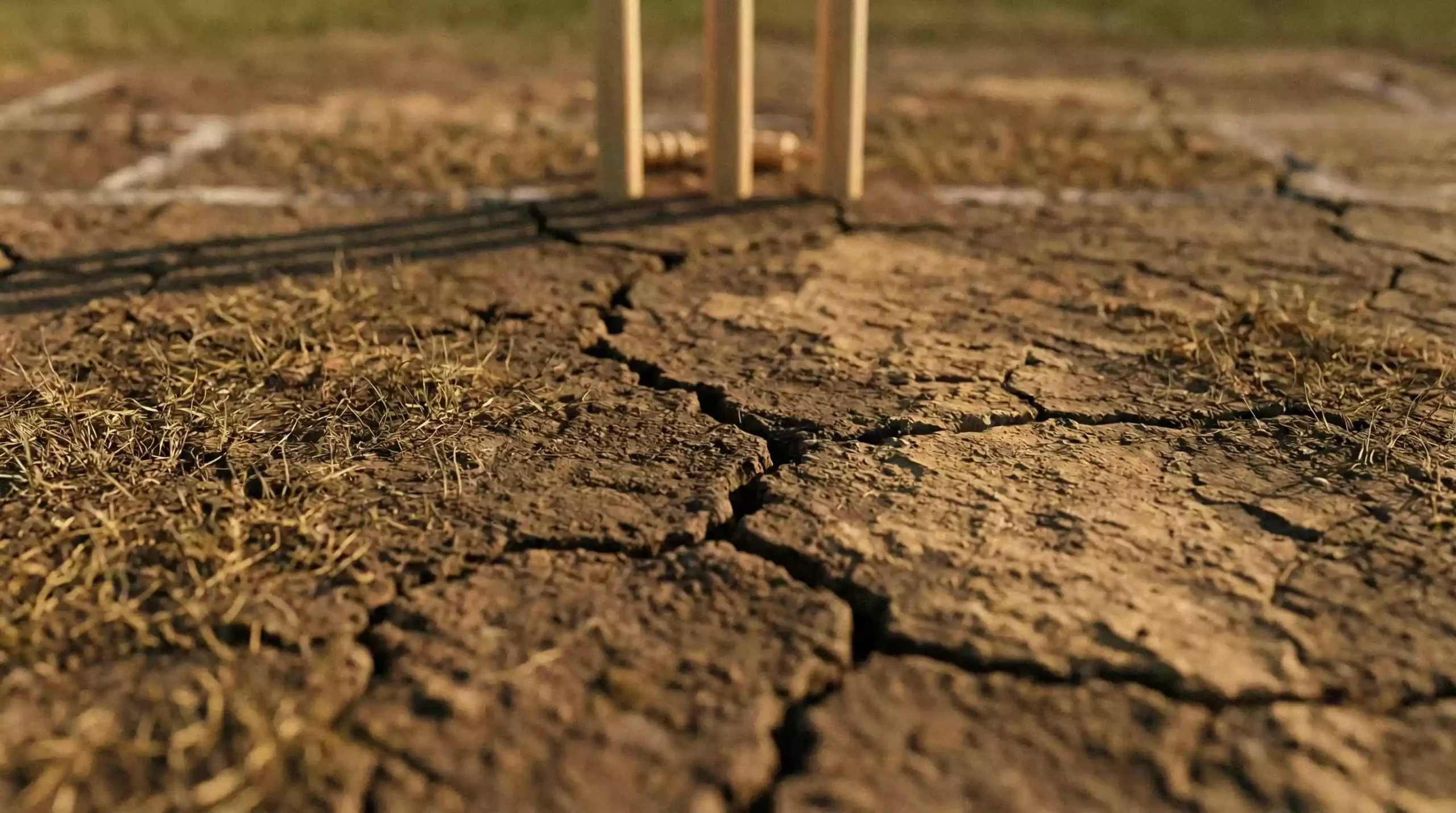
The first thing to assess is the color of the pitch. A greenish tinge indicates grass coverage and potential seam movement. A light brown or straw-colored surface suggests dryness, which usually means less assistance for fast bowlers and more potential for spin as the match progresses. Dark, hard-baked surfaces with visible cracks indicate a pitch that will deteriorate, and the size and distribution of those cracks tell you how quickly. Wide, deep cracks cause uneven bounce, which is the most dangerous variable for batsmen in the later stages of a match.
Moisture content is the second critical factor, and it is harder to assess from a broadcast than color. A pitch with visible moisture — either from overnight dew, recent rain, or heavy watering by the groundsman — will offer early movement for seam bowlers and may slow down as it dries. Listen for the curator’s comments about watering schedule and rolling, as these directly affect how the pitch will play in the first session. A lightly rolled pitch retains more moisture near the surface, while a heavily rolled surface is harder and faster.
The third element is the soil type, which determines how the pitch wears. Red soil pitches, common in India and Sri Lanka, tend to crack and turn earlier than black cotton soil pitches, which hold together longer but can become unpredictable when they do break up. Curators in Australia often use a blend of clay and sand that produces hard, bouncy surfaces, while English pitches are typically prepared with heavier clay that retains moisture and aids seam movement. Understanding the soil type at a particular venue gives you a baseline expectation for how the pitch will behave, which you can then adjust based on the specific conditions you observe.
Which Betting Markets Are Most Pitch-Sensitive
Not all betting markets respond equally to pitch conditions, and knowing which markets are most sensitive helps you focus your pitch analysis where it matters.
Match winner markets are affected by pitch in the broadest sense — green top favors the stronger pace attack, dust bowl favors the better spin unit — but the relationship is mediated by the toss, team composition, and other factors. The pitch alone rarely tells you who will win, but it significantly shifts the probabilities in ways the market sometimes underappreciates, especially at neutral venues where historical data is scarcer.
Over/under runs markets are the most directly pitch-sensitive. A green top with overcast conditions might warrant a first-innings total under 250 in Test cricket, while the same teams on a flat deck under clear skies could produce 400-plus. The line set by bookmakers reflects their pitch assessment, so the value opportunity exists when your pitch reading differs from theirs. This is where watching the actual pitch footage rather than relying on written reports gives you an edge — you might spot dampness or cracks that a brief text summary glosses over.
Top bowler markets respond strongly to pitch type. On a seaming surface, fast bowlers with upright seam positions and the ability to hit the deck hard are disproportionately likely to take wickets. On turning pitches, spinners become the primary wicket-takers, and the market for top bowler shifts accordingly. The value play is in identifying when the market has correctly identified the pitch type but incorrectly priced which specific bowler will benefit most. A left-arm spinner on a pitch turning away from right-handers might be undervalued compared to an off-spinner on the same surface, simply because the angle of turn creates more dismissal opportunities.
Method of dismissal and fall of first wicket markets are also pitch-driven. On bouncy pitches, catches to the wicketkeeper and slips are more frequent. On low, slow surfaces, LBW and bowled dismissals increase as batsmen play across the line to deliveries keeping lower than expected. These specialty markets are less efficiently priced than match or total markets, and pitch-informed analysis can generate consistent value here.
The Pitch You Cannot See
Here is what most pitch analysis misses: the pitch you see in the broadcast is not necessarily the pitch the match will be played on. Groundsmen prepare multiple pitches on a square, and the match pitch is often not confirmed until close to game time. In multi-match series, pitches used earlier in the series will be adjacent to the new pitch, and their wear can give you clues about the underlying soil behavior.
More importantly, the pitch changes during the match in ways that pre-match analysis cannot fully capture. A pitch that starts green can dry out in afternoon sun and become a completely different surface by the second day. A surface that looks flat on the morning of a T20 might develop dew in the evening that transforms batting conditions entirely. The best pitch analysis is not a static assessment before the toss — it is a dynamic, continuous reassessment that feeds into your live betting throughout the match. Bettors who treat the pitch as a fixed input are leaving information on the table that those who treat it as a living, changing variable can exploit.
